
Around the North
The first round-the-world sailing trip through the Northern Hemisphere.

Back in 1521, Spanish sailors completed the first round-the-world journey. This winter, two racing boats are trying to beat the record for sailing around the world. They're going 6 times faster than the Spanish caravels, but besides the direction of rotation, their route hasn't changed much: a 22,000 nautical mile trip via the three capes.
In the North, melting Arctic ice is revealing a new ocean. The once-frozen sea is becoming navigable, opening up wild coastlines. In the summer of 2026, we will sail around the world, without engines, via the North, via the Arctic. A shortcut and an unprecedented route made possible by ingenious and daring navigational choices.
Support the challenge by clicking here.
Support the challenge by clicking here.
.png)
Simplicity and Reuse
The method: bring an old racing boat back to life and use 100% second-hand equipment, from solar panels to dry suits.The goal: a carbon footprint 1,500 times lower, to show that an ambitious and exciting sporting project can be carried out with minimal impact and to promote reuse!
This circular approach is in line with the low-tech and DIY ingenuity involved in adapting the boat to a new route. It is an opportunityfor a powerful story: a human and sporting adventure with a minimal footprint that embodies the values of circularity!
Click here to support our approach.
This circular approach is in line with the low-tech and DIY ingenuity involved in adapting the boat to a new route. It is an opportunityfor a powerful story: a human and sporting adventure with a minimal footprint that embodies the values of circularity!
Click here to support our approach.

The Ocean
The melting Arctic ice is opening up a new ocean and revealing wild coastlines. Due to rising temperatures, over the years, less ice forms in winter and more melts in summer. North of Greenland, Canada, or Siberia, the melting ice pack is making the once-frozen sea navigable.
By analyzing satellite images from recent summers and how ice conditions have changed, we've confirmed it's doable. A determined team with a perfectly suited sailboat can successfully sail through both the Northeast Passage, north of Eurasia, and the Northwest Passage, north of America. By doing this, we'll complete a round-the-world trip via the shortest route. Now it's up to us to prove it in practice!
By analyzing satellite images from recent summers and how ice conditions have changed, we've confirmed it's doable. A determined team with a perfectly suited sailboat can successfully sail through both the Northeast Passage, north of Eurasia, and the Northwest Passage, north of America. By doing this, we'll complete a round-the-world trip via the shortest route. Now it's up to us to prove it in practice!
Nicolas Marcillaud
I'm a skipper who specializes in high latitudes. I've sailed in Greenland, Svalbard, Antarctica, Norway... and I also work in Paris, where I founded Toolbox Studio, an on-demand content production company. I'm a qualified Yachtmaster Ocean (STCW) and Medical 3. For the past five years, adventure has really taken on a salty flavor for me; even if I often head to the mountains, I use sailboats to get there.
Meeting the Unexpected
I dreamed up this journey four years ago and gathered everything needed to make it happen. I've had many sailing experiences in cold waters on boats from 18 to 60 feet, becoming an experienced skipper. I've designed and tested all the necessary technical solutions.
Today, the North still pulls me like a compass. I'm setting off on this voyage for the unknown and the unexpected, for the adventure they represent. I'm going to be surprised every day and always find solutions to whatever comes up. I'm going for the detours and the counter-currents, to take a different path, to start with a blank slate. I'm going to keep learning and growing, to better grasp and understand Arctic weather systems and ice behavior. Finally, I'm going to immerse myself in the Arctic, gently get to know it, and with every mile traveled, become a little more than just a passing guest.
Today, the North still pulls me like a compass. I'm setting off on this voyage for the unknown and the unexpected, for the adventure they represent. I'm going to be surprised every day and always find solutions to whatever comes up. I'm going for the detours and the counter-currents, to take a different path, to start with a blank slate. I'm going to keep learning and growing, to better grasp and understand Arctic weather systems and ice behavior. Finally, I'm going to immerse myself in the Arctic, gently get to know it, and with every mile traveled, become a little more than just a passing guest.

.jpeg)
Supported by the Guild
Paul Émile Victor, Hubert de Chevigny, Sébastien Roubinet, Éric Brossier... since 1967, the European Raid Guild has embodied a spirit of daring and adventure in the highest latitudes. The Guild's financial and symbolic support through its Adventure Grant is a guarantee of technical credibility for the project as well as a accelerator.
SUPPORT THE PROJECT THROUGH THE GUILD
SUPPORT THE PROJECT THROUGH THE GUILD
.jpeg)
Original and Daring Technical Choices
Long periods of light wind mean we need a powerful sailboat to keep moving, yet light enough to be pulled by hand. An offshore sailboat, able to handle the big swells of the North Atlantic and the choppy seas of Baffin. A boat we can haul onto the ice or a shore for shelter, giving us the freedom to be daring among the ice fields. But it also needs to be tough and repairable with whatever we have on board, no matter what.
Unlike polar expedition ships or offshore racing yachts, we're choosing lightness and speed. We'll be sailing a fast, one-ton trimaran, thoroughly adapted based on what we've learned from our previous voyages. Our way of sailing is like alpine style in mountaineering: a small, self-sufficient team, simple and light gear, and a human-sized sailboat that keeps us close to the environment.
Unlike polar expedition ships or offshore racing yachts, we're choosing lightness and speed. We'll be sailing a fast, one-ton trimaran, thoroughly adapted based on what we've learned from our previous voyages. Our way of sailing is like alpine style in mountaineering: a small, self-sufficient team, simple and light gear, and a human-sized sailboat that keeps us close to the environment.
Spirit
Lightness, simplicity and frugality
Discretion, immersion and autonomy
Ingenuity and adaptability

7,500 nautical miles of circumnavigation, with 4,700 nautical miles in the Arctic
2 months of sailing
1 boat
2 crew members
3 oceans

Pull off a sporting and technical feat
Completing an Arctic circumnavigation without any motor assistance is a truly unique sailing feat, demanding technical ingenuity, endurance, and adaptability to the environment. It's going to be a notable first!
Celebrate the wild spirit of the Arctic.
The Arctic is one of the last places where you can truly experience self-reliance and isolation. Guarded by its ice and remoteness, it's been inaccessible, dangerous, and hostile, keeping industry and tourism at bay until now. But this natural protection is fading, making it easier for projects to exploit the Arctic. The days when only icebreakers or brave scientific expeditions dared to go there are coming to an end. If the ice cap melts, we'd love to see the Arctic as something more than just a huge oil reserve or a trade route: a playground for life and the spirit of adventure.

October 24 - January 25
Getting Started and Planning
- Choosing and Getting the Boat
- Building the Crew
- Theoretical study and routing simulations, using 4 years of archived weather & satellite data
- Designing the tech solutions needed for this trip
- Handling administrative matters (procedures, visas, permits)

January 2025 - May 2026
Preparation and Training
- Delivering the sailboat to Lorient and refit: a complete structural check, making it more reliable and lighter.
- Preparing and specifically adapting the boat: simplifying maneuvers, increasing sail area, structural reinforcements, pedal drive, safety systems, and so on.
- Sea trials, iterations, and validations
- Team training and coaching.
July - September 2026
Expedition
- Departure in July 2026
- Arrival in September 2026
October - December 2026
Post-Expedition
- Promoting the expedition through a series of events
- Boat refit and exhibition in Lorient and Paris, on the Seine.
Lightness
BY LIMITING OUR TECHNICAL GEAR, WE EMBRACE OUR VULNERABILITY AND FIND AN UNMATCHED CLOSENESS WITH THE ELEMENTS.
Water just inches away, the wind on our cheeks, and ice at our fingertips. Our way of sailing is like alpine style in mountaineering: a small, self-sufficient team, simple and light gear, and a human-sized sailboat that brings us closer to nature. We embrace our vulnerability and find an unmatched closeness with the elements.
Simplicity
OUR STRATEGY TO REACH OUR GOAL
In a tough environment, we go for simple, robust, and repairable things. We constantly adapt to the Arctic environment and aim to work with it rather than fight it.
Moderation
NAVIGATING DISCREETLY THROUGH A FRIENDLY ENVIRONMENT
Moderation also reflects a view of humanity in the wild and a travel philosophy built on self-sufficiency.
October 2024 - January 2025
Getting Started and Planning
- Choosing and acquiring the boat
- Forming the crew
- Theoretical study and routing simulations, using 4 years of archived weather & satellite data
- Designing the technical solutions needed for this navigation
- Managing administrative matters (procedures, visas, permits)

July - September 2026
Expedition
- Departure in July 2026
- Arrival in September 2026
January 2025 - May 2026
Preparation and Training
- Delivering the sailboat to Lorient and refit: a complete structural check, making it more reliable and lighter.
- Preparing and specifically adapting the boat: simplifying maneuvers, increasing sail area, structural reinforcements, pedal drive, safety systems, and so on.
- Sea trials, iterations, and validations
- Team training and coaching.

October - December 2026
Post-expedition
- Promoting the expedition through a series of events
- Boat refit and exhibition in Lorient and Paris, on the Seine.
LOGBOOK
News from Paradox

In the world of sailing challenges, the usual approach often involves new builds, loads of new gear, and a mindset of constant replacement. On top of the geographical challenge (sailing around the world through the Northern Hemisphere, purely by sail), we're adding a methodological challenge to minimize the expedition's impact. To achieve this, our technical decisions are driven by two main ideas: reuse and moderation.
.jpeg)
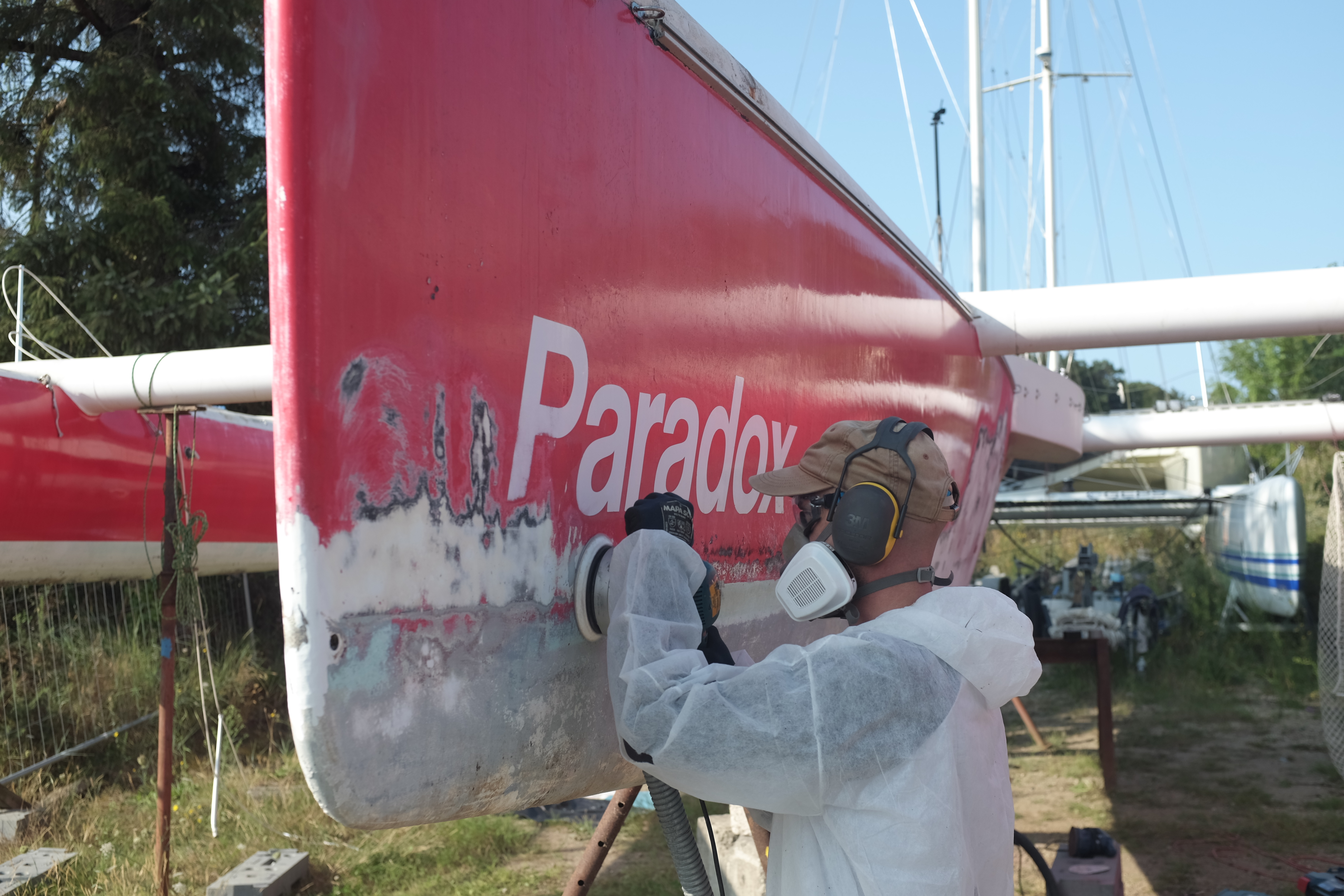
Built to take on the British seas, and a winner of legendary races like the Fastnet and the Round Britain & Ireland, Paradox has seen its share of victories, storms, and even some damage. We picked it for its versatility, performance, and simplicity. Now, it's getting ready to write a new chapter in its story.

How we developed a specific routing module to simulate our journeys through the ice

La Caletta - Lorient: 1700 nautical miles as a warm-up! (article in progress)