
In the beginning: the boat
The first decision was not to build a new boat. The temptation was strong: a new boat would be guaranteed to be tailor-made and perfectly suited to our idea of the ideal boat for this expedition. It would also be a boat built with all the technical advances of recent decades: more efficient design, materials, fittings, etc.
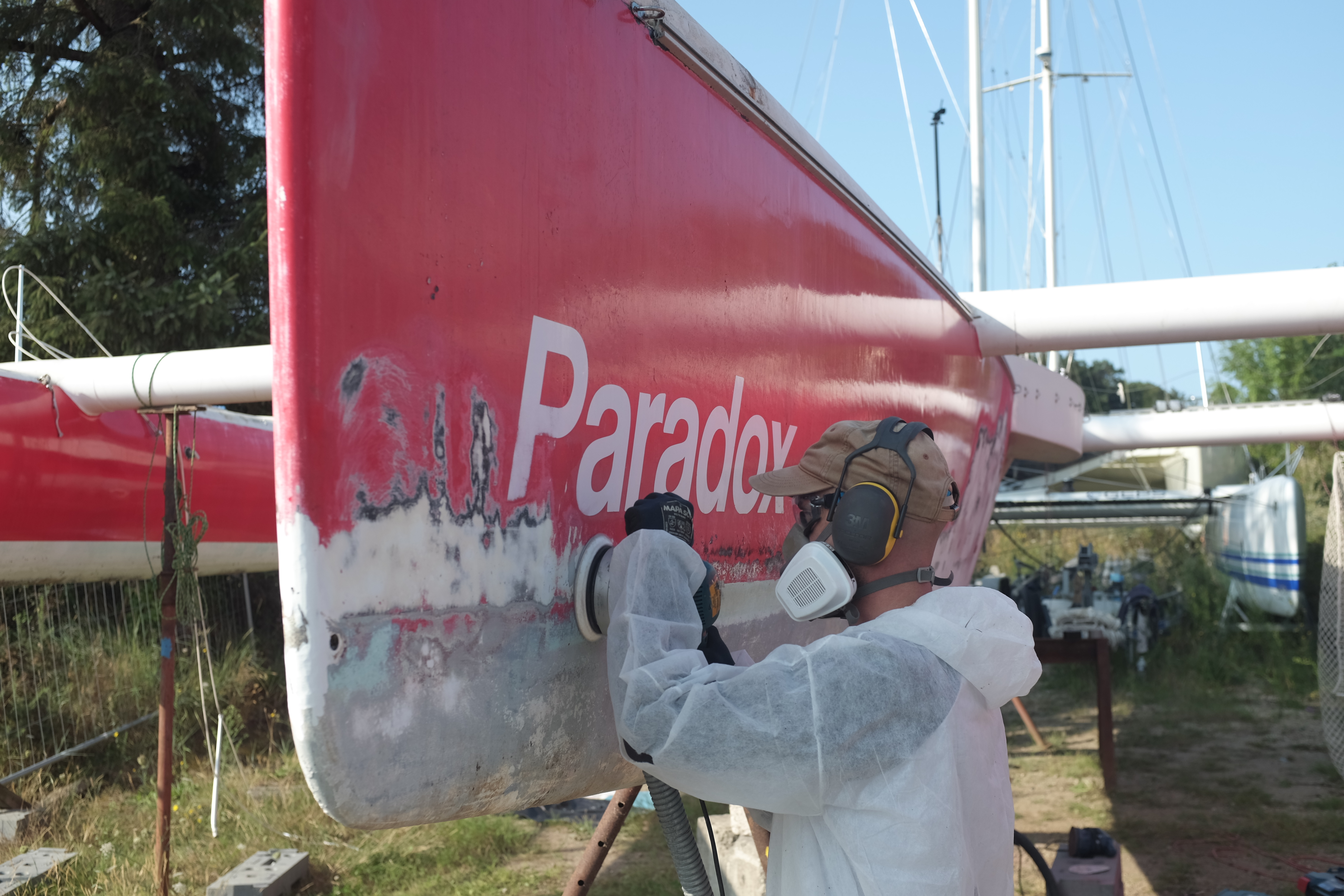
But building a specific boat when the number of existing boats is already disproportionate to their use seemed absurd to me. The decision was therefore made to find an existing boat and adapt it thoroughly to the specific requirements of the Passer par le Nord expedition. The search was long, but the criteria were simple: we had to find the boat that came closest to the specifications of the ideal boat! And we found a 25-year-old trimaran with a unique history: Paradox.
Reuse: a reconditioned boat and equipment
In 2022, I worked for a few months at a marine electrical and electronics company. In this market, where Raymarine reigns supreme, talking about planned obsolescence is an understatement: every week, I would climb a mast at least half a dozen times to replace faulty anemometers. This crucial equipment was prone to frequent breakdowns, partly due to its exposed position at the top of the mast. From an electronic point of view, the design of an anemometer sensor is fairly simple and should be repairable. However, each time, the procedure was the same: dismantle the wind vane and replace it with a new one. And this scenario was repeated for most of the equipment we were working on.
Marine electronics are a prime example of the almost total disregard for the repairability and long-term life of equipment. However, bringing a decommissioned racing boat back to life for an ultra-ambitious nautical challenge would not be enough if reuse were limited to the vehicle itself. For the Passer par le Nord expedition, the goal is to place reuse at the heart of every technical choice! This means equipping ourselves entirely with reconditioned or second-hand equipment, or reconditioning the equipment ourselves by replacing defective parts, renovating, etc.
=> Making the most of what we have: We mainly use secondhand, refurbished, or self-manufactured equipment, thereby limiting the consumption of new resources.
Sobriety: a project on a human scale
Extending the life of equipment—and giving it multiple lives—significantly reduces the impact of shipping. But the first step is to limit consumption! The Passer par le Nord project was designed to be a human-scale project: a small team, minimal logistics, minimal equipment, and simplicity in technical choices. These factors also ensure reliability, efficiency, and repairability, which is imperative in the hostile conditions and isolated areas we will be traveling through!
Why this choice?
- Environmental responsibility: Nautical challenges can be extremely polluting. Our approach aims to significantly reduce our carbon footprint, breaking with the race for novelty and consumption.
- Technical and philosophical challenge: We want to prove that it is possible to achieve great things with little, relying on ingenuity rather than unlimited resources. It's a way of "thinking differently" about performance and maritime adventure.
- Reliability in extreme conditions: In the Northwest and Northeast Passages, far from any assistance, the ability to repair oneself with simple solutions is crucial.
- Accessibility and human scale: Our approach keeps the project on a human scale, both in terms of preparation and budget, making it more accessible.
Reuse is now one of the main aspects of Passer par le Nord. By making it an integral part of the project, the aim is also to share this approach and spread it throughout the world of sailing, sport and, more generally, society and business. We therefore plan to document our methods and the reconditioning of the boat and equipment! Paradox and the expedition will thus become a kind of "demonstrator" of the concrete implementation of circular logic.

.jpeg)